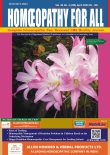
Publisher: HFY Enterprises
Online ISSN: 0973-9823
Number of issues per year: 12
Frequency: Monthly
Review Process: Single Blind Peer Review, Refereed Journal
Homoeopathy for All is committed to maintaining the highest standards of publication ethics, editorial integrity, transparency, and responsible scholarly publishing. The journal expects authors, editors, reviewers, and the publisher to follow ethical principles throughout the submission, review, publication, and post-publication processes.
The journal is committed to promoting honest, accurate, responsible, and scientifically sound scholarly communication.
Authors submitting manuscripts to Homoeopathy for All must ensure that:
Authors must submit original work. Manuscripts should not contain plagiarized material, including copied text, ideas, data, figures, tables, or images from previously published or unpublished work without proper acknowledgement.
All sources used in the preparation of the manuscript must be appropriately cited.
The journal may use plagiarism-detection tools to examine submitted manuscripts. Manuscripts containing substantial plagiarism, duplication, or unattributed material may be rejected.
Authors must not submit the same manuscript simultaneously to more than one journal.
A manuscript submitted to Homoeopathy for All must not have been previously published elsewhere, except where the journal's editorial policies specifically permit disclosure of preprints or previously published conference abstracts.
Authors must clearly disclose any closely related manuscripts that have been published, submitted, or are under consideration elsewhere.
Authorship should be limited to individuals who have made substantial intellectual contributions to the research or manuscript.
Authors should have contributed significantly to areas such as:
Conceptualization or study design;
Data collection or clinical investigation;
Analysis or interpretation;
Preparation or critical revision of the manuscript; and
Approval of the final version for publication.
All listed authors must approve the final manuscript and agree to its submission.
Individuals who have contributed to the work but do not meet the criteria for authorship should be appropriately acknowledged.
Guest, gift, honorary, or ghost authorship is not acceptable.
Authors are responsible for ensuring that the information, observations, clinical findings, data, and references presented in their manuscript are accurate.
Fabrication, falsification, manipulation, or selective reporting of data is considered serious research misconduct.
Authors may be asked to provide supporting data, ethical approval documents, clinical records with appropriate anonymization, or other relevant information during editorial assessment.
Authors should immediately inform the Editorial Office if they discover a significant error or inaccuracy in their submitted or published work.
Where necessary, the journal may publish a correction, expression of concern, retraction, or other appropriate notice.
Research involving human participants must have been conducted in accordance with applicable ethical principles and institutional requirements.
Where applicable, authors must confirm that:
Appropriate ethical approval was obtained before the study commenced;
Participants provided informed consent where required;
Privacy and confidentiality were protected;
Personal identifying information was removed unless explicit consent for publication was obtained.
The name of the approving ethics committee or institutional review board should be provided where applicable.
The journal reserves the right to request documentary evidence of ethical approval.
Case reports and clinical articles must protect the identity and privacy of patients.
Authors must not publish information that could identify a patient unless appropriate written informed consent for publication has been obtained.
Identifying details may include, but are not limited to:
Names;
Photographs;
Hospital or institutional identification numbers;
Addresses;
Personal medical information.
Patient information should be anonymized wherever possible.
Authors are responsible for presenting clinical observations and therapeutic claims accurately and responsibly.
Manuscripts should clearly distinguish between:
Clinical observations;
Individual case experiences;
Traditional knowledge;
Hypotheses;
Literature-based evidence; and
Findings supported by systematic scientific research.
Authors must avoid misleading, exaggerated, unsupported, or unsubstantiated claims regarding diagnosis, prevention, treatment, or cure.
Clinical information published in the journal is intended for scholarly and professional purposes and should not replace professional medical judgement, diagnosis, or applicable medical standards.
Authors must disclose all financial, professional, institutional, personal, or other relationships that could influence, or reasonably appear to influence, the research or interpretation of the manuscript.
Examples may include:
Employment;
Consultancies;
Research funding;
Honoraria;
Patents;
Commercial relationships; or
Institutional affiliations.
If no conflict of interest exists, authors should include an appropriate statement declaring that there are no conflicts of interest.
Authors must disclose all sources of financial support for the research or manuscript.
The role of the funding organization, where applicable, should also be disclosed.
Editors are responsible for ensuring that editorial decisions are based primarily on:
Relevance to the journal's scope;
Originality;
Scientific and scholarly quality;
Clarity;
Ethical compliance; and
Contribution to the field.
Editorial decisions must not be influenced by an author's nationality, gender, ethnicity, religion, institutional affiliation, seniority, commercial interests, or personal relationships.
Editors must maintain the confidentiality of submitted manuscripts and should not use unpublished material for personal benefit.
Editors must declare and appropriately manage conflicts of interest.
Homoeopathy for All uses peer review as an important part of its editorial evaluation process.
Reviewers are expected to:
Maintain confidentiality;
Provide objective and constructive comments;
Evaluate manuscripts fairly;
Identify relevant ethical or scholarly concerns where possible;
Declare conflicts of interest; and
Avoid using unpublished information for personal benefit.
Reviewers should not accept a review assignment if they have a significant conflict of interest or lack the necessary expertise.
Manuscripts received for editorial evaluation are confidential documents.
Editors, reviewers, and editorial staff must not disclose information about a manuscript to unauthorized persons.
Unpublished information obtained through the editorial or peer-review process must not be used for personal advantage.
Editorial decisions are made independently on the basis of scholarly merit, ethical standards, relevance, and quality.
Commercial, financial, institutional, or personal interests should not improperly influence editorial decisions.
The journal takes allegations of publication misconduct seriously.
Possible misconduct may include:
Plagiarism;
Data fabrication;
Data falsification;
Duplicate publication;
Manipulation of images or data;
False authorship;
Undisclosed conflicts of interest;
Ethical approval violations;
Peer-review manipulation; or
Other forms of research or publication misconduct.
Where concerns are raised, the journal may investigate the matter and request clarification or supporting documentation from the authors and relevant institutions.
Where an error or ethical problem is identified after publication, the journal will take appropriate action.
Depending on the circumstances, this may include:
A correction may be published when an error affects the accuracy or clarity of the article but does not invalidate its main findings.
An expression of concern may be issued when serious concerns exist but an investigation is incomplete or the available evidence is insufficient for a final conclusion.
An article may be retracted when there is reliable evidence of serious misconduct, significant errors, plagiarism, fabricated data, unethical research, duplicate publication, or other circumstances that substantially undermine the integrity of the published work.
Retraction notices will clearly explain the reason for the action where appropriate.
Authors who believe that an editorial decision was made unfairly may submit an appeal with a clear explanation and supporting information.
Complaints regarding editorial processes, publication ethics, or alleged misconduct will be considered by the Editorial Office and appropriate editorial authorities.
The publisher supports editorial independence and is committed to maintaining the integrity of the scholarly record.
The publisher will work with editors, reviewers, authors, and relevant institutions to address ethical concerns and maintain appropriate publication standards.
Homoeopathy for All is committed to responsible publishing practices and continuous improvement of its editorial and ethical standards.
All participants in the publication process—authors, editors, reviewers, and the publisher—share responsibility for maintaining the integrity, credibility, and quality of the scholarly record.
Publisher: HFY Enterprises
Online ISSN: 0973-9823
Number of issues per year: 12
Frequency: Monthly
Review Process: Single Blind Peer Review, Refereed Journal


Login to access subscriber-only resources.
