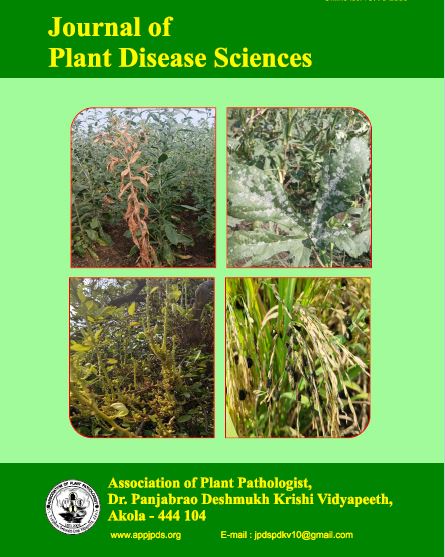
ECO-FRIENDLY APPROACHES FOR THE MANAGEMENT OF CHARCOAL ROT OF SOYBEAN CAUSED BY (TASSI.) GOID. MACROPHOMINA PHASEOLINA
DOI:
https://doi.org/10.48165/jpds.2026.21.01.07Keywords:
Charcoal rot Macrophomina phaseolina, Management, Seedling mortality, SoybeanAbstract
Charcoal rot of soybean caused by Macrophomina phaseolina (Tassi.) Goid. is a major yield-reducing and economically important disease of soybean. Under favourable environmental conditions, the pathogen causes substantial losses and can become destructive at all growth stages of the crop. Yield losses of up to 30% due to charcoal rot have been reported in the Marathwada region of Maharashtra. Biological control agents such as Trichoderma spp. and Pseudomonas spp., applied as seed treatments, soil applications, and foliar sprays, have been found effective against the pathogen while also promoting crop growth. To develop an eco-friendly, low-cost, and indigenous technology for producing disease-free soybean seeds, a field experiment was conducted using different bioagents and botanical formulations. Among the treatments, Trichoderma asperellum (seed treatment @ 10 ml kg⁻¹ seed in 100 ml water + foliar spray @ 10 ml/100 ml water at 30, 45, and 60 DAS) proved to be the most effective, recording 93.33% field emergence, the lowest seedling mortality (7.00%, 12.33%, 14.00%, and 15.00% at 15, 30, 45, and 60 DAS, respectively), and the highest shoot length (30.33 cm), root length (15.35 cm), and dry weight (8.30 g plant⁻¹) at 45 DAS. The next best treatment was Herbal Kunap Jal (seed treatment @ 10 ml kg⁻¹ seed in 100 ml water + foliar spray @ 10 ml/100 ml water at 30, 45, and 60 DAS), which recorded 90.33% field emergence, seedling mortality of 4.66%, 15.66%, 16.66%, and 18.66% at 15, 30, 45, and 60 DAS, respectively, and shoot length, root length, and dry matter of 28.96 cm, 14.33 cm, and 4.93 g plant⁻¹, respectively, at 45 DAS. The results suggest that Trichoderma asperellum is an effective eco-friendly option for the management of charcoal rot and improvement of soybean seedling vigour.
References
Ehlam, K., Muhammad, M. A. J., Fahrul, H., Siavosh, R., Soleiman, J., & Roswanira, A. W. (2016). Evaluation of Trichoderma isolates as potential biological control agents against soybean charcoal rot disease caused by Macrophomina phaseolina. Biotechnology & Biotechnological Equipment, 30(3), 479–488.
Govindappa, M., Lokesh, S., Raib, V. R., Naik, V. R., & Raju, S. G. (2010). Induction of systemic resistance and management of safflower root rot caused by Macrophomina phaseolina by biocontrol agents. Archives of Phytopathology and Plant Protection, 43(1), 26–40.
Rajeswari, B., Rao, K. C., & Kumar, C. P. (2002). Efficacy of antagonists and carbendazim against dry root rot of mungbean (Vigna radiata) incited by Macrophomina phaseolina under glasshouse conditions. Journal of Biological Control, 13(1–2), 93–99.
Shahid, S., & Khan, M. R. (2016). Biological control of root rot on mungbean plants incited by Macrophomina phaseolina through microbial antagonists. Journal of Plant Pathology, 15(2), 27–39.
Shinde, S. P., Ambadkar, C. V., Falke, S. A., & Nirwal, K. P. (2025). Evaluation of biopolymer-based Trichoderma and actinomycetes against wilt and root rot complex of safflower. Journal of Plant Disease Sciences, 19(2), 149–154. https://doi.org/10.48165/jpds.2024.19.02.11
Singh, S., Varma, P., & Chand, H. (2007). Evaluation of fungal antagonists against Macrophomina phaseolina causing root rot of mungbean. Legume Research, 30, 6–8.
Sreedevi, B., Charitha Devi, M., & Saigopal, D. V. R. (2011). Isolation and screening of effective Trichoderma spp. against the root rot pathogen Macrophomina phaseolina causing mungbean blight. Journal of Agricultural Technology, 7(3), 623–635.
Thombre, B. B., & Kohire, O. D. (2018). Efficacy of systemic and non-systemic fungicides against Macrophomina phaseolina. International Journal of Chemical Studies, 6(2), 3054–3057.
Patil, M. G., Kalpande, H. V., Wankhede, M. P., Chapke, S. M., Nirwal, K. P., & Khandare, P. M. (2026). Eco-friendly approaches for the management of charcoal rot of soybean caused by Macrophomina phaseolina (Tassi.) Goid. Journal of Plant Disease Sciences, 21(1), 40–44. https://doi.org/10.48165/jpds.2026.21.01.07