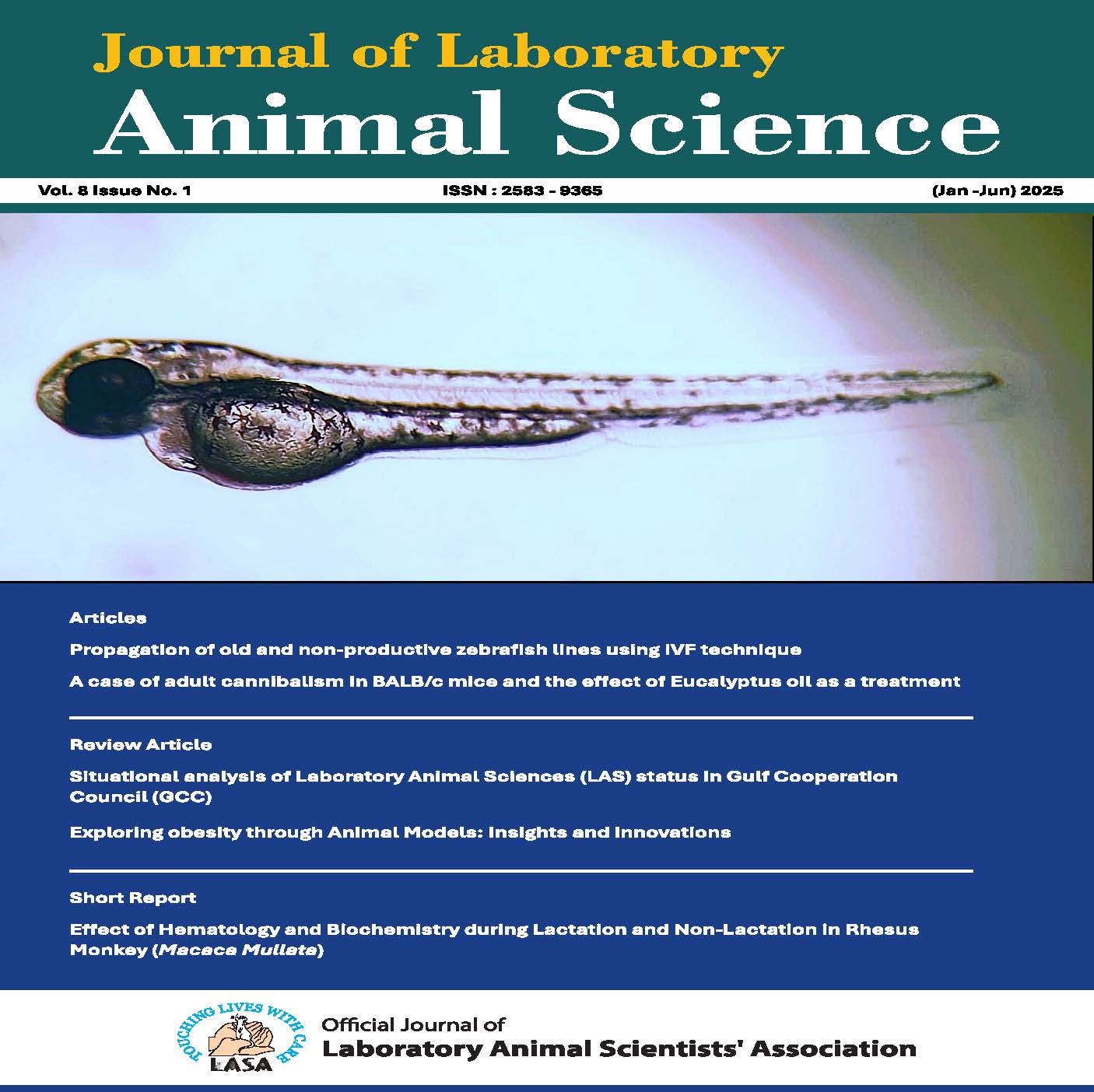
Cardiac blood sampling for glucose estimations in the laboratory zebrafish (Danio rerio)
DOI:
https://doi.org/10.48165/jlas.2026.9.2.1Keywords:
Blood collection, anesthesia, cardiacAbstract
The zebrafish model has gained widespread popularity among the global research community due to its ever-increasing use in basic biology research, drug discovery, chemical safety assessment, and other areas. Several laboratory procedures, including the estimation of hematological, biochemical, and serological parameters in healthy and disease conditions, require blood sampling from laboratory animals. In zebrafish, blood is one of the least-explored tissues due to the organ ism’s small size. The existing methods are tedious and difficult to obtain blood from this species. The researchers used several approaches to collect blood samples from different sites, including lateral incision, decapitation, tail amputation, and cardiac puncture. In all these techniques, researchers have used different numbers of animals and obtained varying volumes of blood. The scarcity of blood obtained by these methods also limits the analysis of many biochemical and cytological parameters. We adopted a cardiac puncture approach for blood sampling in anesthetized adult zebrafish. The blood sampling from adult male and female zebrafish was successfully carried out, and the collected blood volume ranged between 2-10 μl per adult fish. The blood specimens were used for the random blood glucose estimations. The mean blood glucose levels measured were lower in males than in females in all five lines, with a significant difference in the AB line. Due to the significant mortality anticipated with this approach, this method may not be suitable for repeated sampling; however, it can be considered for terminal bleeding.
Downloads
References
Abdullah, N. R., Sharif, F., Azizan, N. H., Wan-Mohtar, W. A. A. Q. I., Chowdhury, A. J. K., & Nasir, M. H. M. (2024). In-house device fabrication for multiple blood sampling of adult zebrafish, Danio rerio. Desalination and Water Treatment, 319, 100522. https://doi.org/10.1016/j.dwt.2024.100522
Babaei, F., Ramalingam, R., Tavendale, A., Liang, Y., Yan, L. S. K., Ajuh, P., Cheng, S. H., & Lam, Y. W. (2013). Novel blood collection method allows plasma proteome analysis from single zebrafish. Journal of Proteome Research, 12(4), 1580–1590. https://doi.org/10.1021/pr3009226
Ben-Zvi, I., Karasik, D., & Ackert-Bicknell, C. L. (2023). Zebrafish as a model for osteoporosis: Functional validations of genome-wide association studies. Current Osteoporosis Reports, 21, 650–659. https://doi.org/10.1007/s11914-023-00831-5
Carvan, M. J., Dalton, T. P., Stuart, G. W., & Nebert, D. W. (2000). Transgenic zebrafish as sentinels for aquatic pollution. Annals of the New York Academy of Sciences, 919, 133–147.
Choi, E. K., Choi, B. M., Cho, Y., & Kim, S. (2023). Myelin toxicity of chlorhexidine in zebrafish larvae. Pediatric Research, 93, 845–851. https://doi.org/10.1038/s41390-022-02186-6
Eames, S. C., Philipson, L. H., Prince, V. E., & Kinkel, M. D. (2010). Blood sugar measurement in zebrafish reveals dynamics of glucose homeostasis. Zebrafish, 7(2), 205–213. https://doi.org/10.1089/zeb.2009.0640
Jagadeeswaran, P., & Sheehan, J. P. (1999). Analysis of blood coagulation in the zebrafish. Blood Cells, Molecules, and Diseases, 25(3–4), 239–249.
Jagadeeswaran, P., Sheehan, J. P., Craig, F. E., & Troyer, D. (1999). Identification and characterization of zebrafish thrombocytes. British Journal of Haematology, 107(4), 731–738. https://doi.org/10.1046/j.1365-2141.1999.01763.x
Kari, G., Rodeck, U., & Dicker, A. P. (2007). Zebrafish: An emerging model system for human disease and drug discovery. Clinical Pharmacology & Therapeutics, 82(1), 70–80.
Keller, E. T., & Murtha, J. M. (2004). The use of mature zebrafish (Danio rerio) as a model for human aging and disease. Comparative Biochemistry and Physiology Part C: Toxicology & Pharmacology, 138(3), 335–341.
Kohale, K. N. (2021). Housing and husbandry of zebrafish (Danio rerio) in a laboratory environment. In P. Nagarajan et al. (Eds.), Essentials of laboratory animal science: Principles and practices (pp. 277–311). Springer Nature. https://doi.org/10.1007/978-981-16-0987-9_13
Lieschke, G. J., & Currie, P. D. (2007). Animal models of human disease: Zebrafish swim into view. Nature Reviews Genetics, 8(5), 353–367.
Meeker, N. D., & Trede, N. S. (2008). Immunology and zebrafish: Spawning new models of human disease. Developmental & Comparative Immunology, 32(7), 745–757.
Moss, J. B., Koustubhan, P., Greenman, M., Parsons, M. J., Walter, I., & Moss, L. G. (2009). Regeneration of the pancreas in adult zebrafish. Diabetes, 58(8), 1844–1851. https://doi.org/10.2337/db08-0628
Nordlie, F. G. (2009). Environmental influences on regulation of blood plasma/serum components in teleost fishes: A review. Reviews in Fish Biology and Fisheries, 19(4), 481–564.
Novoa, B., & Figueras, A. (2012). Zebrafish: Model for the study of inflammation and the innate immune response to infectious diseases. In Advances in Experimental Medicine and Biology (Vol. 946, pp. 253–275).
Olsen, A. S., Sarras, M. P., Jr., & Intine, R. V. (2010). Limb regeneration is impaired in an adult zebrafish model of diabetes mellitus. Wound Repair and Regeneration, 18(5), 532–542.
Pedroso, G. L., Hammes, T. O., Escobar, T. D., Fracasso, L. B., Forgiarini, L. F., & da Silveira, T. R. (2012). Blood collection for biochemical analysis in adult zebrafish. Journal of Visualized Experiments, 63, e3865. https://doi.org/10.3791/3865
Scholz, S., Fischer, S., Gundel, U., Kuster, E., Luckenbach, T., & Voelker, D. (2008). The zebrafish embryo model in environmental risk assessment: Applications beyond acute toxicity testing. Environmental Science and Pollution Research, 15(5), 394–404.
Sipes, N. S., Padilla, S., & Knudsen, T. B. (2011). Zebrafish as an integrative model for twenty-first century toxicity testing. Birth Defects Research Part C: Embryo Today: Reviews, 93(3), 256–267.
Sprague, J., Clements, D., Conlin, T., Edwards, P., Frazer, K., Schaper, K., Segerdell, E., Song, P., Sprunger, B., & Westerfield, M. (2003). The Zebrafish Information Network (ZFIN): The zebrafish model organism database. Nucleic Acids Research, 31(1), 241–243.
Sprague, J., Bayraktaroglu, L., Clements, D., Conlin, T., Fashena, D., Frazer, K., Haendel, M., Howe, D. G., Mani, P., Ramachandran, S., Schaper, K., Segerdell, E., Song, P., Sprunger, B., Taylor, S., Van Slyke, C. E., & Westerfield, M. (2006). The Zebrafish Information Network: The zebrafish model organism database. Nucleic Acids Research, 34(Database issue), D581–D585.
Sprague, J., Bayraktaroglu, L., Bradford, Y., Conlin, T., Dunn, N., Fashena, D., Frazer, K., Haendel, M., Howe, D. G., Knight, J., Mani, P., Moxon, S. A. T., Pich, C., Ramachandran, S., Schaper, K., Segerdell, E., Shao, X., Singer, A., Song, P., Sprunger, B., Van Slyke, C. E., & Westerfield, M. (2008). The Zebrafish Information Network: The zebrafish model organism database provides expanded support for genotypes and phenotypes. Nucleic Acids Research, 36(Database issue), D768–D772.
Stefani, C. E., Philipson, L. H., Prince, V. E., & Kinkel, M. D. (2010). Blood sugar measurement in zebrafish reveals dynamics of glucose homeostasis. Zebrafish, 7(2), 205–213. https://doi.org/10.1089/zeb.2009.0640
Teame, T., Zhang, Z., Ran, C., Zhang, H., Yang, Y., Ding, Q., Xie, M., Gao, C., Ye, Y., Duan, M., & Zhou, Z. (2019). The use of zebrafish (Danio rerio) as biomedical models. Animal Frontiers, 9(3), 68–77. https://doi.org/10.1093/af/vfz020
Traver, D., Paw, B. H., Poss, K. D., Penberthy, W. T., Lin, S., & Zon, L. I. (2003). Transplantation and in vivo imaging of multilineage engraftment in zebrafish bloodless mutants. Nature Immunology, 4(12), 1238–1246.
Trede, N. S., Langenau, D. M., Traver, D., Look, A. T., & Zon, L. I. (2004). The use of zebrafish to understand immunity. Immunity, 20(4), 367–377.
Vazquez, G. R., & Guerrero, G. A. (2007). Characterization of blood cells and hematological parameters in Cichlasoma dimerus (Teleostei, Perciformes). Tissue and Cell, 39(3), 151–160.
Veldman, M., & Lin, S. (2008). Zebrafish as a developmental model organism for pediatric research. Pediatric Research, 64(5), 470–476. https://doi.org/10.1203/PDR.0b013e318186e609
Westerfield, M. (2007). The zebrafish book: A guide for the laboratory use of zebrafish (Danio rerio) (4th ed.). University of Oregon Press.
Zang, L., Shimada, Y., Nishimura, Y., Tanaka, T., & Nishimura, N. (2015). Repeated blood collection for blood tests in adult zebrafish. Journal of Visualized Experiments, 102, e53272. https://doi.org/10.3791/53272
Zang, L., Shimada, Y., & Nishimura, N. (2017). Development of a novel zebrafish model for type 2 diabetes mellitus. Scientific Reports, 7, 1461. https://doi.org/10.1038/s41598-017-01432-w
Zang, L., Maddison, L. A., & Chen, W. (2018). Zebrafish as a model for obesity and diabetes. Frontiers in Cell and Developmental Biology, 6, 91. https://doi.org/10.3389/fcell.2018.00091